
A vacant half-acre on W Hollandale Drive is listed at $900,000. The Ada County assessor puts the whole parcel — and since it is empty, that is pure land value — at $228,000. The identical mirror lot directly across the building line, 10733 W Hollandale, is assessed at $740,600 with a finished house standing on it (Ada County GIS Parcels service). So the bare lot is asking more than its twin costs with a house included, and it has sat unsold since March 2024, its entire MLS description a single word: "BTVA," Buyer To Verify All. In the previous piece we argued that a low, Wright- and Case-Study-inflected house is a genuinely good fit for this climate, and we drew one in our design study for this lot. This piece answers the next question a serious buyer asks: what would it actually cost to build it — and the answer has a twist, because the expensive part of the equation is not the house.
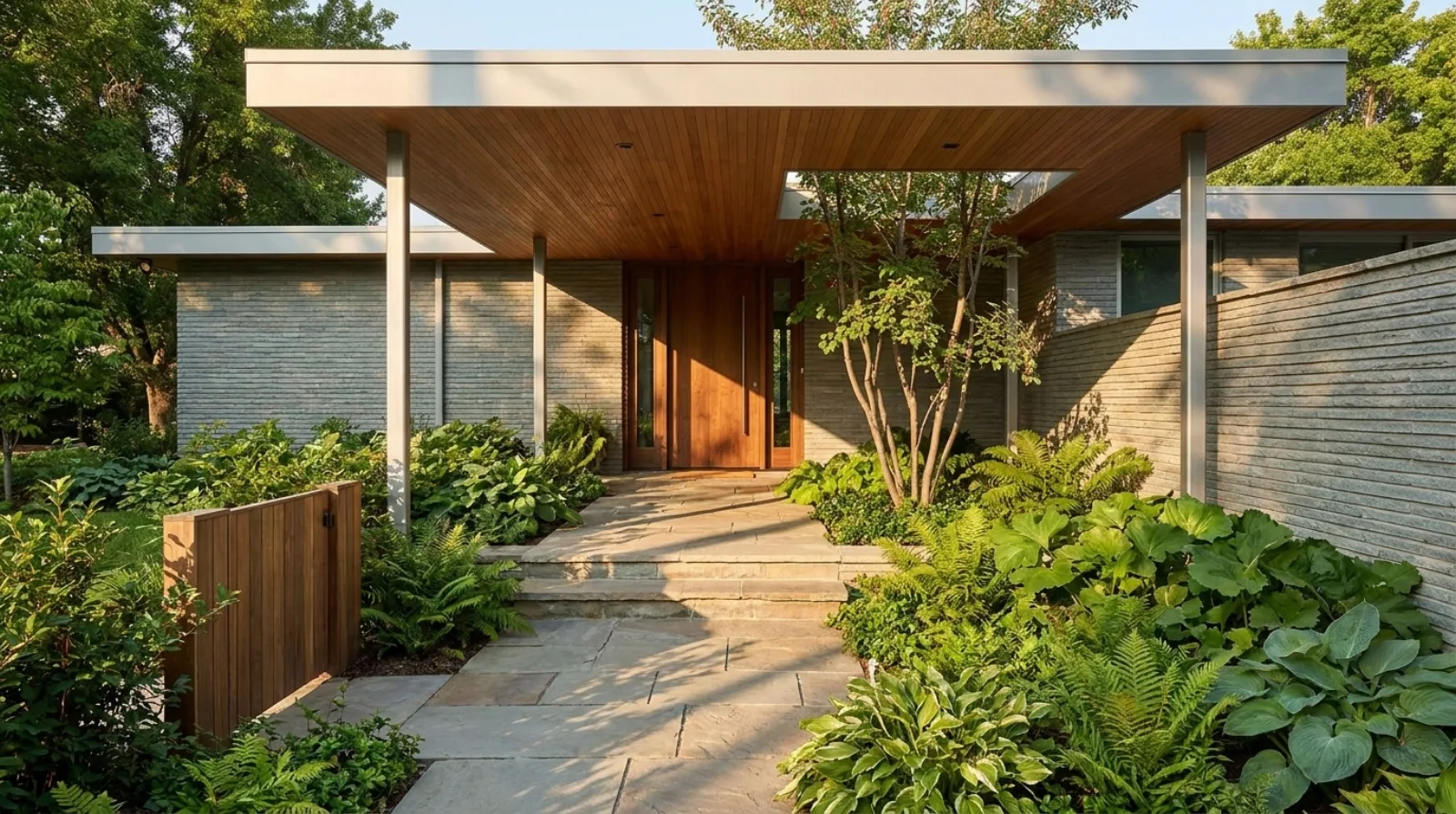
Building in Boise starts around $150 a foot — this house starts above $320
Ordinary new construction in the Treasure Valley runs roughly $150 to $350 per square foot, but the house drawn for this lot sits at the top of the custom market, which begins above $320 a foot. Two independent builders bracket the standard range: Maybon Homes cites $200–$350 per square foot, and Solitude Homes, updated 14 June 2026, gives $150–$350 and prices a 2,500 sq ft house at $375,000–$625,000 before land and finishes. They overlap cleanly at a $350 ceiling for ordinary work, and this is not ordinary work.
For custom construction the sources diverge, and the divergence is worth stating rather than averaging away. A Boise architecture-and-construction firm, publishing 15 January 2026, gives entry-level custom at $225–$260/sf, mid-range at $260–$320/sf, and high-end at $320–$400+ per square foot — a 3,500 sq ft house in the top band landing at $1.12M–$1.4M+. A second Idaho builder, publishing 3 June 2026, uses a noticeably higher scale: standard custom $250–$350/sf, mid-range $350–$475/sf, luxury $475–$650+ per square foot. That second scale is oriented toward Idaho Falls and Teton Valley, not Boise, so its top end does not transfer one-to-one — a caveat, not a correction. What the two agree on is the floor: serious custom work in Idaho in 2026 starts above $320 a foot. The house requested here does not fit inside the ordinary range, and the reason is in the vocabulary itself.
The flat roof's cost is hidden underneath it, not in the membrane
The flat roof is not more expensive as a roof surface — it is more expensive because of the structure it forces below the ceiling. As a surface it can actually come out cheaper: a flat roof covers roughly 13 percent less area than a pitched roof on the same house and lands about 15 percent below a tiled roof, per Today's Homeowner. The membrane itself carries a modest premium, and here the sources openly contradict each other — residential TPO runs $6.50–$11.50 per square foot installed per Schoenherr Roofing, while HomeGuide puts it at $12.00–$17.00 for 2026. The honest reading is that the truth sits somewhere in the overlap around $10–$12 a foot, but no source at all gives a Boise-specific TPO price, so that figure is an estimate rather than a finding.
The real cost is beneath the roof. The long, unbroken spans this idiom wants cannot be carried by the factory trusses of a pitched roof; they need steel, glulam beams or engineered TJI joists, all of them dearer, and a truly flat ceiling forces those beams flush — inside the floor zone rather than hanging below it, which is more work to frame. One architects' discussion puts flat-roofed contemporary houses at 50 to 100 percent above a standard build; that figure appears in a single source and nowhere independently, so it belongs here as an indication of direction, not as a number to plan around.
Exposed steel can double its own price — and that is the AISC's figure, not a builder's guess
Structural steel is only a small premium over wood as raw material, but the moment the steel is meant to be seen, a second premium lands on top that has nothing to do with holding the building up. As framing material, the gap is modest: timber runs $9–$14 per square foot against steel's $12–$18, per Critchfield Construction. But architecturally exposed structural steel — AESS, the steel that is the design rather than hidden inside a wall — carries a fabrication premium for finish, weld treatment and quality control. The American Institute of Steel Construction, the primary industry body, sets that premium at 20–60 percent for its AESS 1 category and 40–100 percent for AESS 2, above standard structural steel. For a house where the beam over the living room is the room's architecture, you are in AESS 2 territory or higher, which means planning on roughly a doubling of the steel line item. This is the one cost driver in the whole exercise that rests on a hard, primary figure instead of a builder's estimate.
The glass wall is $90 to $150 a foot, and the energy code makes it worse
What a Case Study House actually has is not a decorative curtain wall but a load-bearing window wall, and that difference roughly doubles the price before the climate is even considered. A true curtain wall — non-structural facade cladding — runs $25–$80 per square foot per HomeGuide. A window wall that carries load and runs floor to ceiling, which is the real detail here, costs $90–$150 per square foot per HomeAdvisor. On a south elevation of 60 by 10 feet — 600 sq ft of glass — that is $54,000 to $90,000 for a single elevation, with nothing yet spent on overhang, shading or thermal breaks.
Then Boise's energy code sharpens the bill. The city lies in climate zone 5, where Idaho requires a fenestration U-value of 0.32; Boise's own amendment to Table R402.1.2 allows an R-38 ceiling provided the glazing reaches U-0.31 (City of Boise codified text). Idaho adopted the 2018 IECC with amendments and, in February 2026, the legislature rejected a move to the 2024 codes, so that standard holds as of mid-2026 (DOE Building Energy Codes; Idaho Energy Code). Large areas of glass do not reach U-0.31 to U-0.32 with standard products — you move to triple glazing or thermally broken steel and aluminium profiles, exactly where the price per foot climbs and, as the companion article explains, exactly where the thin 1960 sightline is lost. Whether a glass-heavy design like this clears the code through the simple prescriptive route or has to be justified by a full performance calculation is something no source could settle — a real open question, not a rounding error.
The overhangs and cantilevers are a fifth cost that has to be named and cannot be priced. Extended roof edges need moment-resisting connections, more steel and more detailing, but not one source gives a residential price or premium for them, so they sit in the budget as a known unknown rather than a line.
The permit is quick; the fees are not
Getting the permit is measured in weeks, but the fees attached to it run past $23,000, and one of them turns on a question the cost research could not answer from its own sources. Plan review for a fully custom design runs seven to twelve weeks in Boise, and construction itself ten to eighteen months from permit to completion — so with design and engineering ahead of that, count on two and a half to three years from first sketch to keys.
The fees can be pinned down. Boise's FY2026 impact fee schedule, effective 1 October 2025, charges a dwelling over 2,800 square feet in the West Bench Planning Area — where Hollandale sits — $2,857.86 for regional parks, $7,341.70 for local parks, $3,414.81 for fire and $889.80 for police: $14,504.17 in all, plus a one percent surcharge (City of Boise FY2026 schedule). On top of that the Ada County Highway District levies a road fee that rose to roughly $8,900 west of Cole Road, the tier that applies here, confirmed by two independent news reports. Together that is about $23,400, before $1,500–$3,000 in plan-check and permit fees, per a permitting-services guide (PermitFlow).
Here is the reconciliation worth flagging. The cost research left one thing open: the same municipal table shows that parcels in the unincorporated Area of Impact, for which Ada County issues the permit, pay only $1,178.92 in Boise fees instead of $14,504.17 — a swing of more than $13,000 — and it could not establish from its own sources which side of that line the parcel falls on. The zoning research settled it: the parcel is verified to lie within Boise's city limits (Ada County City Limits GIS layer), so the full $14,504.17 applies. It is worth confirming at a concept-review meeting with the city, but the evidence points to the higher figure, not the lower one.
The sum: roughly $2.35 to $3.2 million, all in
Costed out honestly, the finished house lands between about $2.35 million and $3.2 million including the lot — and most of that spread is real, not padding. Take 3,200 square feet, roughly 300 m², appropriate to the program and the half-acre. Price it at $350 per square foot at the low end — the ceiling for ordinary Boise construction and the realistic floor for a flat roof, exposed steel and a glass facade — and $500 at the high end, still below the $650 the luxury scale allows. That is $1.12M–$1.6M in construction alone.
| Line item | Low | High | Basis |
|---|---|---|---|
| Construction, 3,200 sf | $1,120,000 | $1,600,000 | $350–$500/sf |
| Architect's fee (8–20%) | $110,000 | $320,000 | HomeGuide; Letterfour |
| Site work | $8,000 | $30,000 | Abstract R&D |
| Utility connections | $3,000 | $30,000 | Abstract R&D |
| Landscaping | $15,000 | $50,000+ | Abstract R&D |
| Impact & permit fees | ~$25,000 | ~$25,000 | City of Boise; ACHD |
| Contingency (10–15%) | ~$130,000 | ~$300,000 | recommended at this complexity |
| Subtotal, excluding land | ~$1.45M | ~$2.3M | |
| Lot (asking price) | $900,000 | $900,000 | listing |
| Total | ~$2.35M | ~$3.2M |
The architect's fee alone is $110,000 to $320,000, at 8 to 15 percent of construction for custom work and 10 to 20 percent for high-end residential (HomeGuide; Letterfour). A contingency of 10 to 15 percent is not a luxury at this level of structural complexity — it is the line that keeps the project from stopping halfway.
The build is not the problem — the lot is
Every figure above is defensible, and none of it is what breaks the math: the finished house would be worth less than it costs, and the reason is entirely in the land price. The median sale price in ZIP code 83709 is $505,520 (Zillow, a single source that returned a 403 on direct fetch, so read it as one data point rather than two), and Boise-wide the median over the three months to May 2026 was $525,000 (Redfin). A finished house at $2.35M–$3.2M is therefore four to six times the median home in its own ZIP code — not a premium, but a different market on the same street. Even at North Boise's top price-per-foot of about $579, a 3,200 sq ft house would end at roughly $1.85 million (Build Idaho) — less than construction plus land. And this parcel is not in North Boise.
The dominant error in the sum is the lot, not the build. At $900,000 for 0.474 acre, the land alone is $1.9 million per acre and 1.78 times the median home in that ZIP code. For calibration, the neighboring improved R-1A lots on the same street — all about 0.92 acre, twice the size — are assessed between $497,100 and $647,500 with houses on them (Ada County GIS). A lot half that size and empty is being asked at more than any of them. If construction runs $1.45M–$2.3M and the market supports an end value of at most roughly $1.8M for an exceptional house, then the rational land price sits closer to zero than to $900,000; even at $250,000 — still above the $80,000–$300,000 range for a Treasure Valley building lot — the sum is tight but conceivable.
None of that is an argument against the house. It is an argument against this lot at this price. Anyone who wants to build this design in Boise and come out financially whole buys land where the top segment is already proven, or accepts openly that this is a consumption decision and not an investment. Seen that way, the two years unsold are not an obstacle but a negotiating position — and the numbers above, drawn from county records rather than the listing, are what a buyer brings to that conversation.
What this article does not know
Several things stay open, and naming them is the point. No source gives a Boise-specific price for TPO membrane or for steel fabrication, so those line items are ranges, not quotes. No source prices the overhang and cantilever premium in residential construction at all — it is real cost with no number attached. Whether a glass-heavy design clears zone 5 through the prescriptive route or needs a full performance calculation could not be established, and it materially affects the glazing budget. The listing figures themselves — the $900,000 asking price and the time on market — come from the site's own listing and from search-result fragments, because Zillow, Redfin and the broker's page each returned a 403 on direct fetch; the assessed values that anchor the argument ($228,000 for this lot, $740,600 for its twin with a house) are the hard part, verified against Ada County's own GIS. The exact effective date of the higher ACHD road fee rests on a single secondary source and is not confirmed by ACHD itself. And the city-limits question that decides the $13,000 fee swing, while resolved in favor of the higher fee by the zoning research, is the first thing to put in writing at a concept-review meeting with the city.