
Two earlier pieces in this series drew two lines. The video piece was about never changing anything that exists — the walkthrough is built from the home's own photographs and the camera move is the only thing invented. The staging piece was about the opposite direction: when you add furniture that isn't there, you say so, conspicuously, on the image. This piece is about the third and strangest case — a house that does not exist at all.
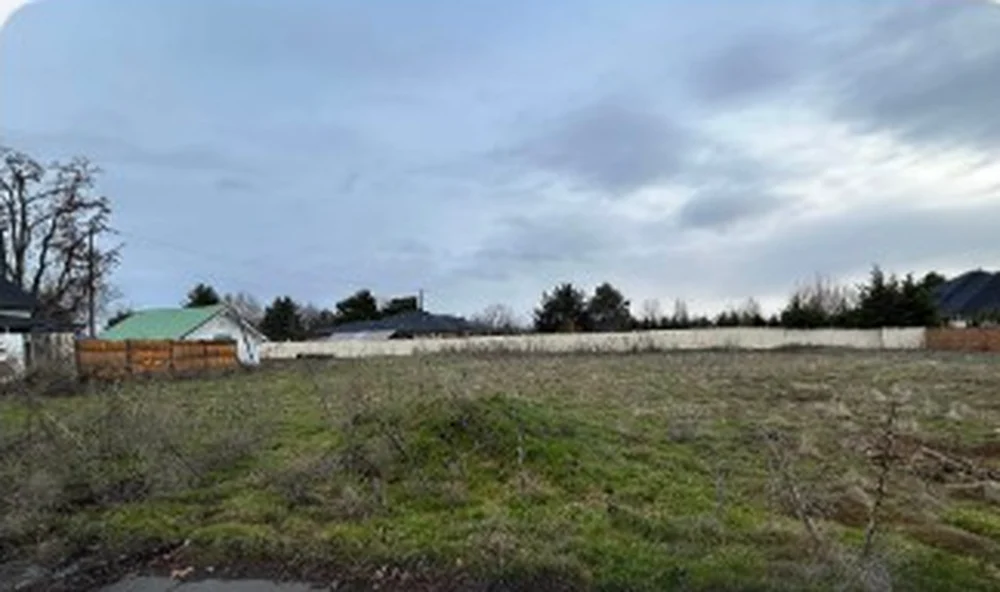
The lot at 10685 W Hollandale Drive is a parcel of dry ground, 0.474 acre, and the MLS listing for it carries exactly one photograph: the empty lot, at the resolution the MLS published it. An empty lot is the hardest thing in real estate to sell, because there is nothing to look at, so we did something that on its face sounds like the most dishonest image you could make — we generated pictures of a house that has never been built and put them on the page. This article is about why that can be more honest than a photograph rather than less, and about the three things you have to do to keep it that way: label it as a proposal everywhere, refuse the parts of sales-photography language that would fool a viewer into thinking it is real, and hold the line against the same MLS rules the earlier pieces were built on.
A render can be more honest than a photograph — because it never pretends to be one
Start with the uncomfortable fact that a listing photograph is not a neutral document either. The single image that defined how we picture modern houses — Julius Shulman's 1960 night shot of the Stahl House in Los Angeles — was, in the photographer's own account, staged. "I set up the furniture and I called the girls... And I planted them there," Shulman said; he described the result not as a record of a building but as "a picture of a mood." The two women in white are not incidental. They supply scale, and they supply the idea that you live a life in this house. Architectural photography has been persuasion, not documentation, since the genre began.
That is what makes the honesty question sharper than it first looks, and also more answerable. A polished twilight photograph of a real house is already a constructed argument for that house; the buyer simply is not told which parts were arranged. A render of a house that does not exist has one advantage no photograph can match: it can be completely honest about what it is. It is not a picture of the property as it stands — it is a proposal of what the ground could hold, and it can say exactly that, in plain words, on every frame. The dishonesty in a listing image is never the fact that it is composed. It is the gap between what the image implies and what the buyer would find on arrival. A labeled proposal of a non-existent building closes that gap by admitting it up front.
Label it as a proposal, everywhere — and show the real ground next to it
The first condition is the same discipline the staging piece laid out, applied harder: the disclosure has to be conspicuous, in plain language, on the page next to the media — never a small watermark in a corner, and never buried in a caption a viewer scrolls past.
On the Hollandale study we say it like this: "None of these images or clips is a photograph of an existing building. No house stands on this lot. They are computer-generated design proposals, made to show what the zoning and the orientation allow — not an approved plan, not a rendering of anything built or permitted, and not included in the sale." That block sits with the renders, not away from them, and it names every way the image could be misread and closes it: not a photo, not built, not permitted, not approved, not for sale.
The second half of the discipline matters as much as the words. The real photograph of the empty lot is shown first and kept on the page — the buyer is always one glance away from the actual ground, exactly as the strict MLS rules on staged photos demand an unaltered original alongside the altered one. The proposal never replaces the truth; it sits beside it. You should be able to see, in the same scroll, both the parcel as it is and the idea of what it could become, and never confuse the two.
Why a render is "a view not physically possible" — and why the lot page is a different case
Here is the hard part, and it is where this piece has to be most careful. The video piece leaned on a content rule from Canopy MLS (Rule 1.18.1) that forbids generating "views ... that are not physically possible from the specified location," and argued that this is a rule about the content of an image, not about labeling it — a burned-in disclaimer discloses a content violation, it does not cure one. A render of a house that was never built is, on the most literal reading, the purest possible example of a view not physically possible from the location: nothing is there to view.
So why is a clearly-labeled design proposal on a lot page a different case from a doctored listing photo? The distinction is what the rule is actually policing. That kind of rule exists to stop a buyer being misled about an existing property — a window given a view it does not have, a room that is not there, an existing photograph edited to show something the location cannot show. The mischief is a false depiction of a real thing. A design proposal for an empty lot is a different act of speech: it does not depict an existing building, because there is no existing building to depict or to misrepresent, and it says so on its face. The rule bites on images a reasonable buyer would take as showing the property as it is. A labeled proposal of a house that does not exist is not that image — provided it is never presented as one.
That "provided" is why the practical architecture is drawn the way it is. The MLS listing itself keeps the one real photograph of the lot as its property image; the design proposals live as clearly-labeled editorial context on our own page, not as MLS listing photos standing in for the property. The real ground goes to the MLS; the idea stays on the site, fenced with disclosure. That separation is deliberate, and it is also the honest answer to the limit of what we can verify. As the staging piece already recorded, the Intermountain MLS rulebook could not be retrieved during our research and no Idaho advertising rule was confirmed — so whether a design render could ever ride on the MLS land listing itself, and under what disclosure, is precisely a question we cannot answer from a rulebook we could not read. Faced with that, the conservative choice is the only defensible one: keep the proposals off the listing and on the page, and treat the reading above — that a labeled proposal is not a prohibited "view" — as our considered interpretation of the rule's purpose, not as a settled holding.
Don't borrow the whole language of a house that's been sold
The second condition is about the picture itself, and it is subtler than "label it." The craft that makes architectural photography read as real is specific and learnable — level camera, verticals kept dead straight rather than converging, the roughly twenty-to-thirty-minute window after sunset when the sky and the interior lights balance, a low camera around chest height that gives furniture its weight, real materials shown the way raking light actually reveals them. Using that craft is not the problem; it is what keeps a proposal legible instead of turning it into a cartoon. The Hollandale evening render is built on exactly that recipe — twenty minutes after sunset, every room lit behind full-height glass.
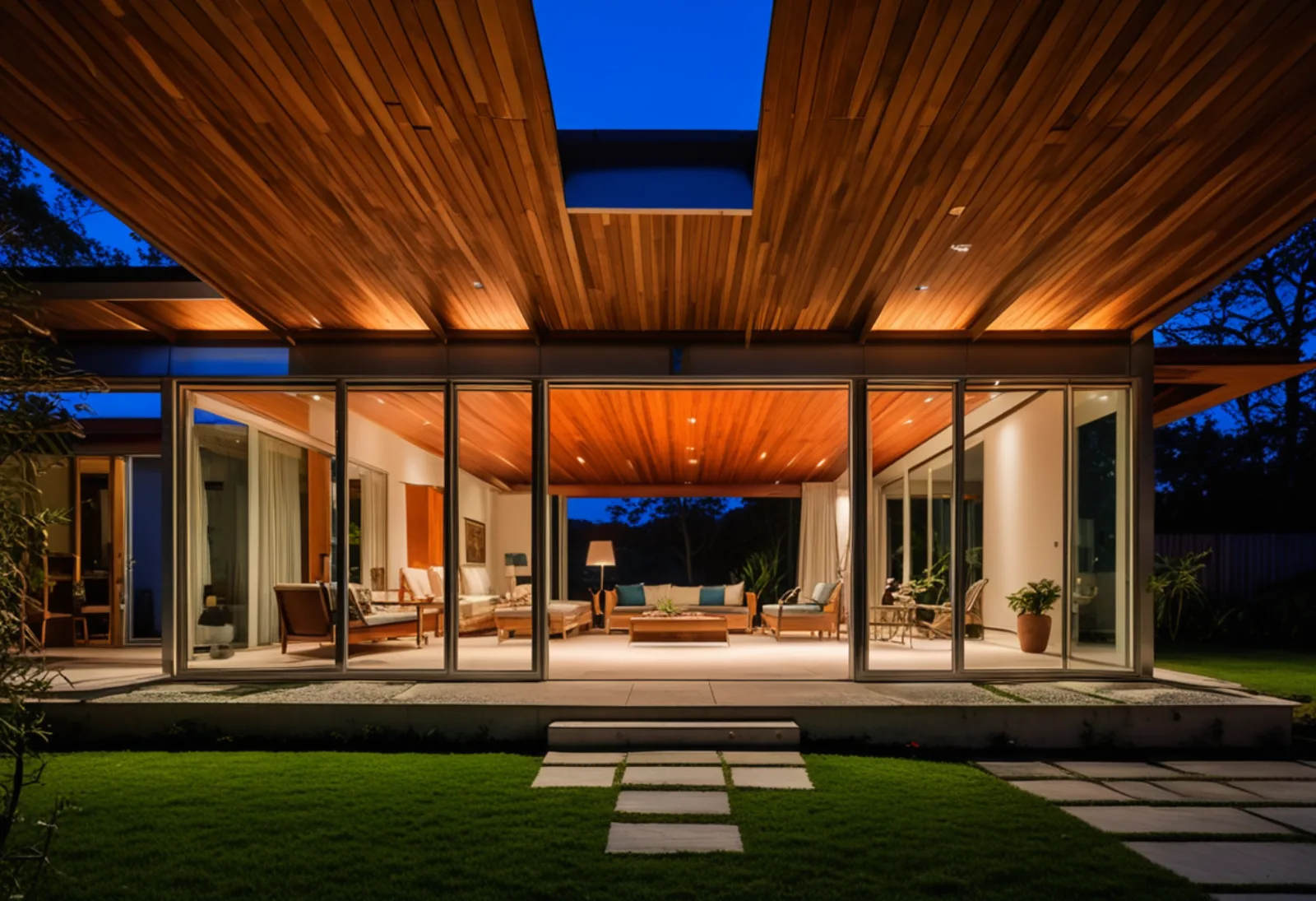
The problem is crossing from craft into a claim of existence. There is a real axis in this genre between two poles: Shulman, who sold a life with people and warmth, and photographers like Marvin Rand, who left people out and let the building stand as an object. A design proposal should lean toward the second. It can be beautiful and technically true; it should stop short of staging a fabricated lived-in life — a family unloading a car, laundry on the line — that quietly implies this is a home you could go and tour on Saturday. The tell we hold onto is small and honest: on the Hollandale page the images are framed as "four directions, not four views." They are not four camera angles of one settled house. They are four explorations of what the lot could become.
That framing is not only editorial tact; the technology forces it to be true. The tools we deliver on give no way to lock a single design across images — none of the levers that would hold one building steady from view to view (a fixed seed, a structural depth or edge conditioning) exists on the platform we use. So four renders of "the Hollandale house" are not, and cannot be, four verified views of one consistent building. Calling them views would be a small lie the software makes impossible to back up. Calling them directions is simply accurate.
The details that give a fake away — and what we do instead
Generative models betray themselves in ways worth naming, because avoiding them is also how we keep the images honest about this lot rather than borrowing someone else's. Left alone, the models tilt the camera up and let the verticals converge, which reads instantly as a holiday snapshot rather than an architectural image; they render glass as a mirror instead of something you can see through. And they carry strong hidden defaults. Ask for "Frank Lloyd Wright" — the second most-named architect across nearly five million analyzed image prompts, at over thirteen thousand mentions — and the name does not hand you his method; it hands you an average of his most photographed building, Fallingwater, which means a wooded plot over a running creek. For a flat, treeless 0.47-acre lot in the high desert, that is the wrong picture entirely.
So we describe structure instead of dropping a name — low, single-storey, deep roof overhang, a clerestory band, long low brick — which steers better and, more to the point here, keeps the proposal about this ground rather than importing the aura of a famous house somewhere else. For the same reason we name no photographers and reproduce no existing building. Style itself is not something copyright protects, but the U.S. Copyright Office has flagged market dilution through stylistic imitation, and specific famous houses carry their own restrictions — the Stahl House's owners expressly prohibit commercial use of "digital renderings" of the house "or its likeness." A render that leans on a real protected building, or is sold as "in the style of" a named photographer, stops being a proposal for our lot and becomes a copy of someone else's work. An honest render does not lie about whose it is, either.
One more thing rides along without our asking: every image from the Gemini-based model available to us carries an invisible SynthID watermark, machine-readable and with no way to switch it off. It is not our disclosure and it is not sufficient on its own, but it does mean a "this was generated" signal travels inside the file itself, underneath the visible label we put on the page.
What this article does not know
The honest edges here are specific, and two of them are the same local gaps the staging piece flagged. The Intermountain MLS rulebook could not be retrieved, and no Idaho advertising or land-render rule was verified — so whether a design render could ever be attached to an MLS land listing, and with what disclosure, is genuinely open, which is exactly why we keep the proposals on our own page and the single real photo on the listing. And the reading at the center of this piece — that a clearly-labeled proposal of a non-existent building is not the kind of "view not physically possible" that content rule was written to forbid — is our considered interpretation of the rule's purpose, not a holding any MLS or court has handed down for this situation.
Two narrower gaps. Whether an emerging disclosure law would treat a design render as a regulated "image" the way California's staging law treats an altered photo is unsettled; as with a video clip, we assume it would and label accordingly rather than wait to be told. And there is a craft gap that is also an honesty gap: no available benchmark measures whether two renders are even the same imagined house, so we cannot claim consistency across a set that the tools cannot guarantee — which is the whole reason we call them four directions and not four views. Where a rule or a capability was solid we said so and named it; where it was not, we said that instead, because on a house that does not exist yet, the labeling is the only thing holding the picture to the truth.