
Virtual staging is legal, ordinary, and everywhere. An empty room photographs as a problem — buyers cannot picture themselves in a space they cannot furnish in their heads — so the room gets filled with a sofa, a rug and a lamp that were never in it, and the listing sells the idea instead of the emptiness. Nobody is hiding anything by doing this; it is a normal, disclosed product across the industry. What gets an agent in trouble is the second half: not saying the furniture is digital, or saying it so quietly that no ordinary buyer would notice. This article is about that second half — what the disclosure obligation actually requires, why a small corner watermark does not satisfy it, what the penalties look like, and where the honest limits of what we could verify sit.
The rule is disclose it, not don't do it
Virtual staging is permitted; the obligation attached to it is to disclose that the image has been altered. The reason it lands in "disclosure" rather than "prohibited" is worth being precise about, because it also draws the line between virtual staging and something that is genuinely forbidden on some services. Staging changes what the photograph depicts — it adds furniture and decor — which is a different act from moving a camera over an unaltered photo. It changes covered content, so it has to be disclosed. But it does not change the room: the walls, windows, ceiling, floor and fixtures stay exactly as photographed. When an edit crosses from adding furniture to altering the physical property — repainting a wall, swapping a floor, editing out a flaw — the analysis changes, and on some multiple-listing services that edit is not merely a disclosure question but outright prohibited, which we come to below.
The governing duty at the national level is the "true picture" obligation. NAR's Code of Ethics, Article 12, requires that agents present a true picture in their advertising, and Standard of Practice 12-10 extends that duty explicitly to "Internet content, images," and bars "misleading images." It is worth knowing what NAR does not say, because a good deal of secondhand advice gets this wrong: no Standard of Practice names artificial intelligence or virtual staging by name, and blog posts that cite "SOP 12-5" or "SOP 12-7" as the staging-disclosure rule are simply mistaken — 12-5 is about putting the firm's name in advertising, and 12-7 is about who may claim to have "sold" a property. The real hook is 12-10 and the general true-picture principle behind Article 12. Undisclosed staging is a problem because a furnished photograph of an empty room is a misleading image, not because a rule somewhere lists the word "staging."
A corner watermark does not meet the standard
The single most common way to get disclosure wrong is to do it, but do it too quietly. Every MLS rule that addresses this converges on the same word — the disclosure has to be conspicuous — and every one of them rejects the small watermark in the corner as insufficient.
Canopy MLS puts it most concretely. Its Rule 1.18.1 (knowledge-base article updated 27 February 2026) requires that "all AI-enhanced and virtually-staged" photos, renderings or virtual tours carry "a clear, readily visible disclosure directly ON the image or within the virtual tour." It then closes the obvious loophole: disclosure provided "ONLY in captions, agent remarks, or supplemental text is NOT acceptable," and "a nonstaged (original) image MUST be included immediately before or after." CRMLS, the largest MLS in the United States, lands in the same place from a different angle — it wants the alteration labeled in the photo-description field, states that a watermark alone is insufficient, and likewise requires the original image immediately before or after the staged one.
Two things follow for anyone producing this media. First, the disclosure belongs on the image and next to it, in plain language, not tucked into metadata or a caption a buyer scrolls past. Second, the honest counterpart to a staged photo is the real one, shown alongside it — the buyer should always be one glance away from the empty room. A small logo in the corner satisfies neither requirement.
CRMLS also marks the boundary that separates staging from something worse. Its rules (11.5(c) and 12.10) state that you "cannot add, remove, or modify actual property components such as walls, flooring, landscaping, or fixtures." On that service, recoloring a wall or swapping a floor is not permitted at all — disclosed or not — while adding furniture to an empty room remains a disclosable edit. That is exactly why disciplined virtual staging keeps its hands off the architecture: the moment a "staging" edit starts repainting walls, it stops being staging and becomes a modification that some MLSs forbid outright.
What it costs to get it wrong
The penalty for undisclosed or non-compliant staging depends entirely on which MLS the listing sits under, and the range is wider than the round numbers that circulate online suggest. At one end, CRMLS as of early 2026 handles violations by correction rather than a fine, with its Rules Committee reviewing monetary penalties for later in 2026. At the other, SDMLS lists a real sanction with teeth for a working agent: suspension of data access. In between, many MLS citation schedules do carry monetary fines, set per violation and escalating with repeat offenses; our own media guidance works to a $500–$5,000 range for those, which is the shape of the risk rather than a single authoritative figure. The precise number is set by each MLS, and we flag below the one that matters here — Idaho's — as something we could not verify.
One number to actively distrust: a $250 penalty figure attached to California's staging law circulates widely and is not supported by any primary source we could find. It should not be repeated to a client as fact. The honest summary is that the monetary exposure ranges from nothing (a correction) to loss of MLS access to per-violation fines in the hundreds-to-low-thousands, and that the reputational and liability cost of a misled buyer sits behind all of it regardless of the dollar figure.
California drew the clearest line — and Idaho hasn't
The most useful thing to read right now is not an MLS rule but a state statute, because it shows where this is all heading. California's AB 723 (Chapter 497, Statutes of 2025, approved 10 October 2025, effective 1 January 2026) adds Section 10140.8 to the Business and Professions Code, and it is the clearest articulation anywhere of what "disclose it properly" means. It requires two things at once: a "reasonably conspicuous" statement, "on or adjacent to the image," that the image has been altered — and "a link to a publicly accessible internet website, URL, or QR code" that leads to the original, unaltered image. A conspicuous label and a path back to the truth, together.
Several details make it a good template even outside California. It is deliberately not AI-specific: "photo editing software or artificial intelligence" are treated identically, so the rule turns on whether the depiction changed, not on which tool changed it. It carves out the ordinary edits that do not change what the property looks like — lighting, sharpening, white balance, color correction, angle, straightening, cropping, exposure — which is the same distinction that keeps a plain camera move over an unaltered photo out of "altered image" territory in the first place. It reaches beyond the licensee to "person acting on their behalf," so the vendor producing the media is inside the obligation, not outside it. And where the licensee controls the posting site, subsection (a)(2) goes a step further than a link: the unaltered images must be in the posting, not merely reachable through it.
Here is the boundary that has to be stated plainly, because it is the whole reason to call California a signpost rather than the law: Idaho is not California, and AB 723 does not govern a Boise listing. It tells us where regulation is moving, and it is a sound standard to hold ourselves to voluntarily — but it is not binding here. What is binding here is the Intermountain MLS rulebook and any Idaho advertising rule, and this is where we have to be honest about the edge of our own knowledge: during our research the IMLS rulebook could not be retrieved, and no Idaho advertising rule was verified. We are not going to paraphrase a rule we could not read. The correct next step, before any staged image goes on an Idaho listing, is to get the current requirement from Intermountain MLS member services directly — not from an article, including this one.
How we handle it
Our own policy is built to sit on the safe side of even the strictest of those rules, and the clearest place to see it is the Re-imagine feature on the listing at 2377 S Aburge Ave. The flex room there has no closet, which is precisely why what it should be is genuinely the buyer's open question, so we show it three ways — a home office, a guest room, and a small gym. The honesty of the technique is in that choice: an empty room is the one a buyer cannot picture, and a room whose use is undecided is real information a buyer can act on. We deliberately did not frame it as a renovation. The house was built in 2020 and is already modern; a dated-to-modern "transformation" would have no story here and would misrepresent the property.
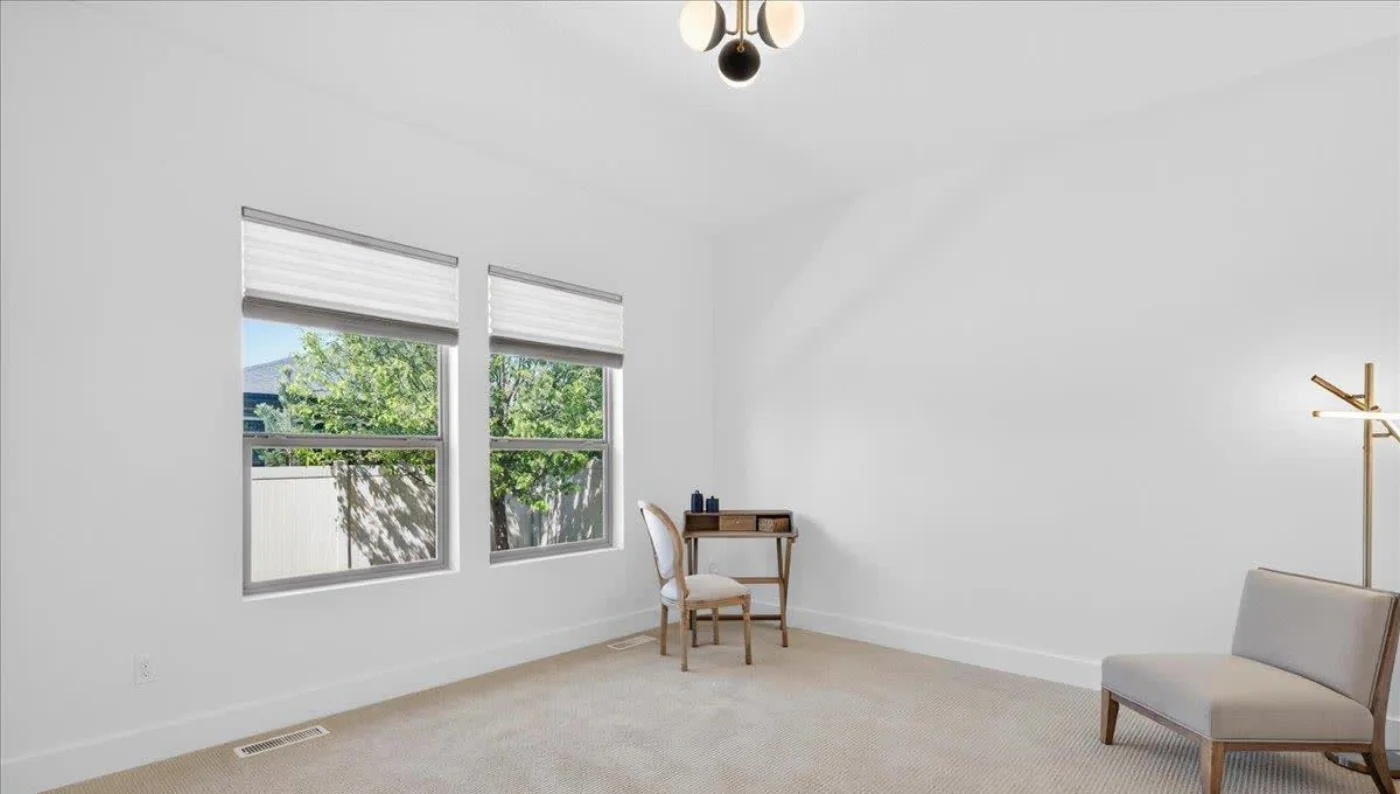
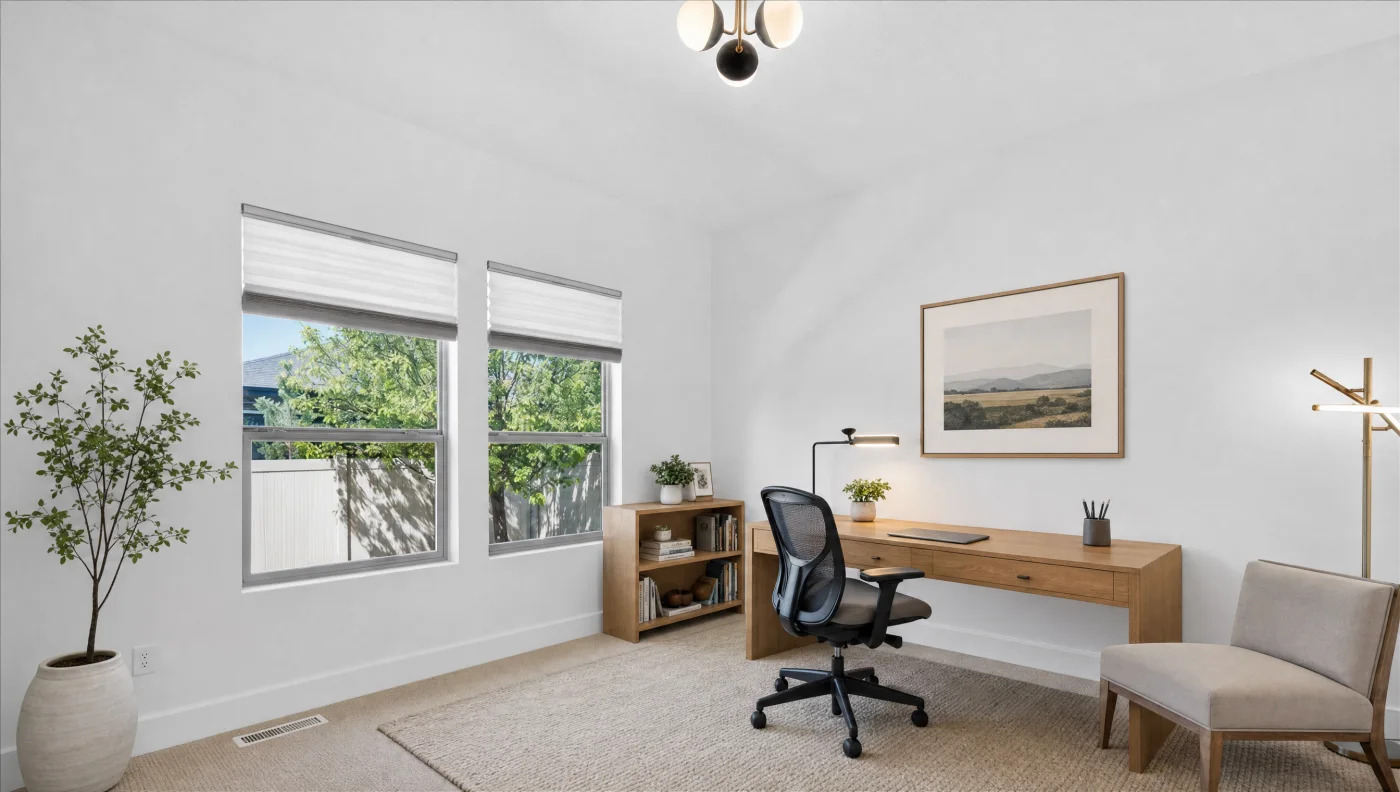
Underneath, the method is locked to the architecture. Every one of those three images keeps the same walls, both windows and the identical view, the blinds, the sloped ceiling, the globe light, the carpet, the skirting, the floor vent and the camera angle — each verified against the original photograph. Only the furniture and decor change. Nothing structural moves, which is what keeps it on the right side of the CRMLS line above: this is staging, not modification.
And it is disclosed the way the rules ask — conspicuously, on the page, next to the media, in plain words rather than a watermark. The block we place reads: "Virtually staged. The furniture and decor in these images and clips are digitally added and are not included in the sale. The room, its windows, ceiling, flooring and light fixture are unchanged from the photograph." We consider that the working standard, not the finished one. The wording of an AI-disclosure that goes live on a real listing has to come from Alyssa Goade-Munch and Shannon Allen, REALTORS®, and their broker — not from us, the vendor. Our text is a draft they can adopt, sharpen, or replace; the responsibility for what a buyer is told about their own listing stays with the licensed agents.
What this article does not know
The honest edges are specific, and they belong on the page rather than out of sight.
The two that matter most are local. The Intermountain MLS rulebook could not be retrieved during our research, and no Idaho advertising rule was verified — so for a Boise listing, the precise disclosure requirement and the precise penalty are things to confirm with IMLS member services, not to infer from California or North Carolina. That local uncertainty is why every dollar figure in the penalties section is framed as a range and a shape of risk rather than a fixed fine.
Two narrower gaps: whether a short video clip counts as an "image" under AB 723's language is not settled by the statute we read, so the safe assumption is that it does and should be disclosed the same way; and the $250 figure that floats around the California law is unsupported by any primary source and should not be repeated. Where a rule was clear we cited it and the body that issued it; where it was not, we said so — which is the only reason to trust the parts that are.