
Most listing videos in 2026 are one of two things. Either a videographer walks the house with a gimbal on a scheduled shoot day, or someone feeds a photo into an AI tool and lets it improvise — and the AI, left alone, will happily add a room, warm the light to golden hour, or fill a window with a view the house does not have. The first is honest but slow and priced by the hour. The second is fast and cheap and quietly lies.
We build a third kind, and the entire point of it is that it cannot lie. The video is assembled from the home's own listing photographs, and the only thing that is invented is the camera's movement between two real pictures. Nothing is added, removed, or altered. This article explains exactly how that works, what a finished walkthrough costs us to produce, and where the honest limits of the method are.
The camera move is generated; the house is never touched
A listing walkthrough, the way we make it, is a chain of short clips. Each clip starts from one real listing photo and ends on another real listing photo of the same space, and the software fills in the motion in between — a slow dolly forward through a doorway, a gentle pan across a great room. In the trade this is image-to-video with start and end keyframes: you hand the model two fixed pictures and it interpolates the seconds that connect them. The house at both ends of every clip is the photographed house. The model's only job is the walk.
That two-real-photos structure is the whole design, not a detail. On Higgsfield's Kling 3.0 — the hosted model we deliver on — the interface exposes exactly two image slots, a start image and an end image, for clips of three to fifteen seconds. Both anchors are real photographs, so the generated seconds are pinned at both ends to something that actually exists. There is a faster, cheaper variant of the same model that drops the second slot and takes only a start frame; we do not use it, because losing the end frame means losing the second real anchor, and the second anchor is the thing the whole method rests on.
The rules that govern the generation are deliberately restrictive. No extending a room past the edge of the frame. No adding or removing furniture. No turning day into dusk or summer into fall. No filling a window with a different view, and no making a space look larger than the photograph supports. When a move is in doubt, the answer is always less motion, not more. A calm dolly that is correct beats a spectacular sweep that warps the walls.
Staying the real house is a legal line, not a taste
The reason for all of that restraint is not aesthetic. Alyssa Goade-Munch (Idaho license #SP49684) and Shannon Allen (Idaho license #SP33315) are licensed agents, and a video that presents a property as nicer or other than it is, is misrepresentation to buyers. A generated flourish that most viewers would read as "just video magic" is, on a listing a licensed agent is marketing, a professional-liability problem. So the constraint is drawn where the license is drawn.
There is a sharper version of this that is easy to miss, and it is worth stating plainly because it changes what a disclaimer can and cannot fix. At least one large multiple-listing service, Canopy MLS, writes into its rules (Rule 1.18.1, updated 27 February 2026) that agents may not generate "views ... that are not physically possible from the specified location." That is a rule about the content of the image, not about labeling it. A frame invented from a camera position where no photo was ever taken is, by construction, a view from a spot no one stood in — and a burned-in "AI-generated" caption does not cure a content violation, it only discloses it. The way you actually stay inside that line is to keep the generated path physically plausible between the two real endpoints: a route a person could have walked, at a speed that does not smear the doorframes. This is the strongest possible argument for the calm, slow move over the cinematic one. The slow version is not just prettier; it is the compliant one.
The same logic forces a second design rule: the video has to be one uninterrupted route. The finished walkthrough sits next to the home's floor plan, and as the video plays a small marker travels across that plan so a viewer always knows where in the house they are. If the video jumps around illogically — kitchen, then a far bedroom, then back to the entry — that marker walks through walls and the illusion of a real tour collapses. So the walking order is decided before a single clip is generated: entry, living, kitchen, dining, hall, bedrooms, bath, primary suite, in an order that physically matches the plan. Each room gets roughly four to six seconds, with the kitchen and primary suite running a little longer and a hallway a little shorter.
What a finished walkthrough costs
Here are the numbers we can stand behind, because we measured them on our own tours. A single clip is cheap either way; a whole listing is still cheap. The variable that matters is which of two production routes you run it on.
| Item | Hosted route (Higgsfield, Kling 3.0) | Self-hosted route (Modal, LTX-2.3) |
|---|---|---|
| One 5-second clip | ~10–14 credits ≈ €0.48–€0.67 at top-up rates (€0.0475/credit) | ≈ $0.10 of GPU time (~155 s on an L40S) |
| One full tour, first attempt (9 clips) | 90 credits ≈ €4.28 | ≈ $0.90 |
| One full tour, realistic with retries | ~140 credits ≈ €6.65 (≈ €4.62 on the Ultra plan) | ≈ $1.40 |
| Ten listings a month | ≈ €55 | ≈ $14 |
Credit prices are the live Higgsfield rates fetched 20 July 2026; the dollar column is measured GPU time at $1.95/hour on an L40S. The euro figures are our media production's measured costs — the tours are produced by the team's European media partner — not an amount billed to the agents.
A note of honesty about the credit figure, because our own records disagree with each other and the skill we work from says to write the tension down rather than pick a side. Higgsfield's live pricing on 20 July quoted a five-second Kling 3.0 clip at 10 credits, but our own transaction ledger from 18 July shows six Kling v3.0 charges of 14 credits each. We do not yet know why — a different duration, audio left on, or a mid-month price change are all candidates — so the honest per-clip range is 10 to 14 credits, which is what the table shows. Before we ever quote a client a number we will re-measure it against a fresh ledger, not a marketing page.
The self-hosted route is a factor of five to six cheaper per tour, which sounds decisive until you look at the absolute figures: at ten listings a month it is roughly €55 against $14, a difference of about fifty euros. That is too small to decide anything on its own, and it is not the whole story. The hosted model is genuinely better — the best open-weight models sit around 240 Elo below the Kling class at image-to-video, a gap that matters little for a slow interior dolly but is real. So we treat the two routes as what they are: the hosted route is the delivery path where fidelity has to win, and the self-hosted route is the cheap experimentation path where we iterate on the walking route before committing. The point of publishing both columns is that either way, the media cost of a listing video is a few euros, not a few hundred.
How that compares to hiring a videographer
The traditional route is a person and a day. A videographer schedules a shoot, drives to the house, films it on a gimbal or a slider, and delivers an edit some days later. It produces beautiful work and it has one unarguable advantage over any generated clip: the camera really was there, so there is no question of an invented view. Its costs are the costs of professional time — the shoot, the travel, the edit, the turnaround — and they scale with the hour, which is why a traditional video is a line item you think twice about on a median-priced home.
We are not going to quote you a dollar figure for that route, because we have not commissioned one to price it head-to-head against ours, and inventing a number would break the one rule this whole method exists to honor. What we can say is structural and true: the generated route removes the shoot day and the scheduling from the equation entirely. The photographer still has to visit the house — the whole thing is built from real listing photographs, so someone shoots those — but the video is then assembled from pictures that already exist, in an afternoon, for the price of a few euros of compute. For a home where a full traditional video would be hard to justify, that is the difference between having a walkthrough and not.
What it looks like on the page
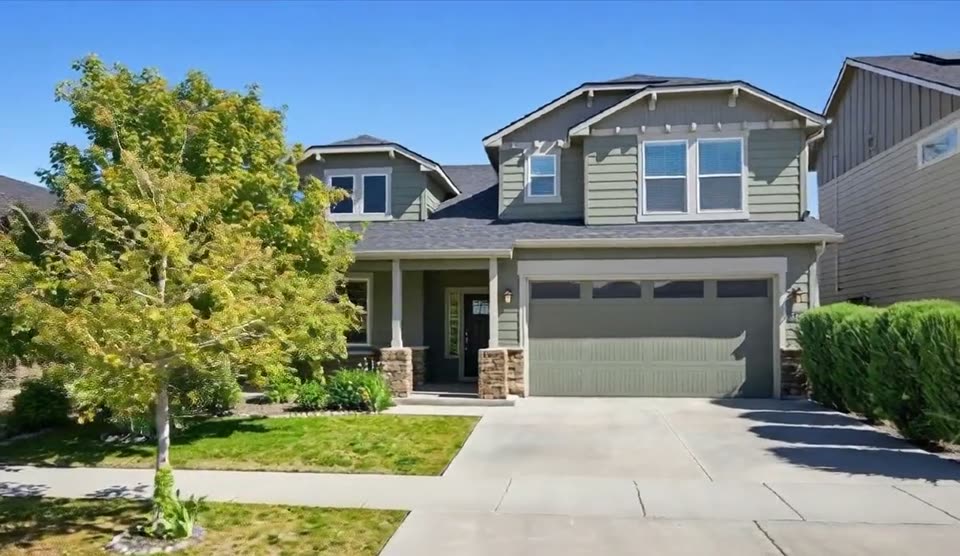
You can watch a finished one now. The listing at 12460 W Azure St carries a fifty-second walkthrough that runs from the sidewalk to the primary bath in seven chapters — Outside, Entry, Great room, Kitchen, Dining, back toward the entry, and Bedroom and bath — each of which you can jump straight to. On listings where we have traced the floor plan, that same video plays beside the plan with the moving camera marker described above; a full plan-synced tour we delivered on another home ran about forty-two seconds across nine route clips.
Every one of those pages carries the same short disclosure, and it is deliberately conspicuous rather than a watermark tucked in a corner. It reads: "The walkthrough is built from this home's own listing photographs, with the camera move generated between them. No room, fixture or finish has been added, removed or altered." We say it in plain language, on the page, next to the video, because the method only means something if the viewer knows what they are watching — and because, as the content rules above make clear, the honest way to use this technology is to be loud about it.
The look itself is intentionally undramatic. Both agents chose bright, natural daylight over the golden-hour filter that smothers most real-estate video, and the moves are slow and steady. No drone swoops through the house, no whip pans, no slow-motion cliché. That restraint is partly taste and partly the same compliance logic: a slow, plausible move is the one that keeps the doorframes where they belong.
What this article does not know
A few things sit outside what we can verify, and they belong here rather than buried.
We have not priced a traditional videographer shoot ourselves, so every cost figure above is for the generated routes only; the head-to-head dollar comparison to a classic shoot is something we would have to commission before we could publish it. The per-clip credit cost is genuinely unresolved between Higgsfield's live pricing and our own ledger, and we have flagged it as a range rather than a point. Kling's own terms of use — commercial rights, output ownership — could not be retrieved during our research (the site blocks automated access), so those live as open questions on the hosted route even though it is our delivery path; Higgsfield's own terms, by contrast, are readable and permissive. And the fidelity gap between hosted and open-weight models is real but unmeasured for the specific thing that matters most here — how rigidly a doorframe holds its line under a slow camera translation — because, as far as we could find, no public benchmark measures that at all. When one exists, or when we build our own, we will say what it shows.